Aging is an inevitable consequence for all organisms. According to the mitochondrial free radical theory of aging (MFRTA), reactive oxygen species (ROS), which are predominantly generated in mitochondria, are assumed to play a key role. While accumulating evidence suggests that calorie restriction (CR) delays aging by improving mitochondrial function, the effects of ROS and CR on mitochondrial protein oxidation remain largely unclear.
|
|
| 
|
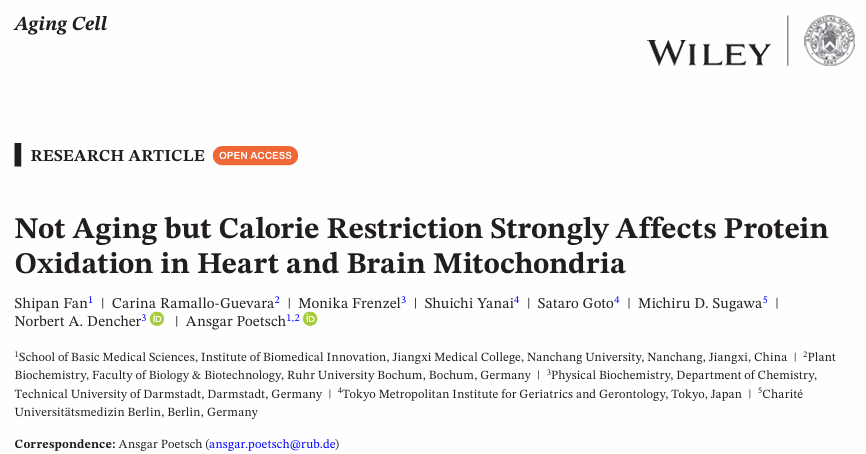
In January 2026, a research team led by Professor Ansgar Poetsch from Institute of Biomedical Innovation / the School of Basic Medical Sciences collaborated with teams from Ruhr University Bochum (Germany), Technical University of Darmstadt (Germany), Tokyo Metropolitan Institute for Geriatrics and Gerontology (Japan), and Charité – Universitätsmedizin Berlin (Germany) to publish a paper in the renowned aging research journal Aging Cell. Entitled “Not Aging but Calorie Restriction Strongly Affects Protein Oxidation in Heart and Brain Mitochondria”, the study utilized unbiased proteomic analysis to systematically reveal, for the first time at the multi-tissue and multi-modification levels, that calorie restriction exerts a significant and tissue-specific regulatory effect on mitochondrial protein oxidative posttranslational modifications.
The research team performed a systematic quantitative analysis of multiple oxidative post-translational modifications (oxPTMs) on mitochondrial proteins from the hearts and brains of young (6.5 months) and aged (27 months) rats, while also investigating the effects of short-term and lifelong calorie restriction interventions. Contrary to the predictions of the MFRTA theory, the study found no significant age-related increase in oxidative levels of mitochondrial proteins in either the heart or the brain. Calorie restriction significantly reduced the global oxidative modification levels of both mitochondrial and transmembrane proteins in the heart, with the effect being particularly pronounced on transmembrane proteins. In the brain, calorie restriction also decreased the oxidation of transmembrane proteins; however, the oxidative levels of mitochondrial proteins were significantly increased. These findings suggest that calorie restriction may extend health span by inducing a state of mild oxidative stress in the brain, thereby activating protective signaling pathways.
|
|
| 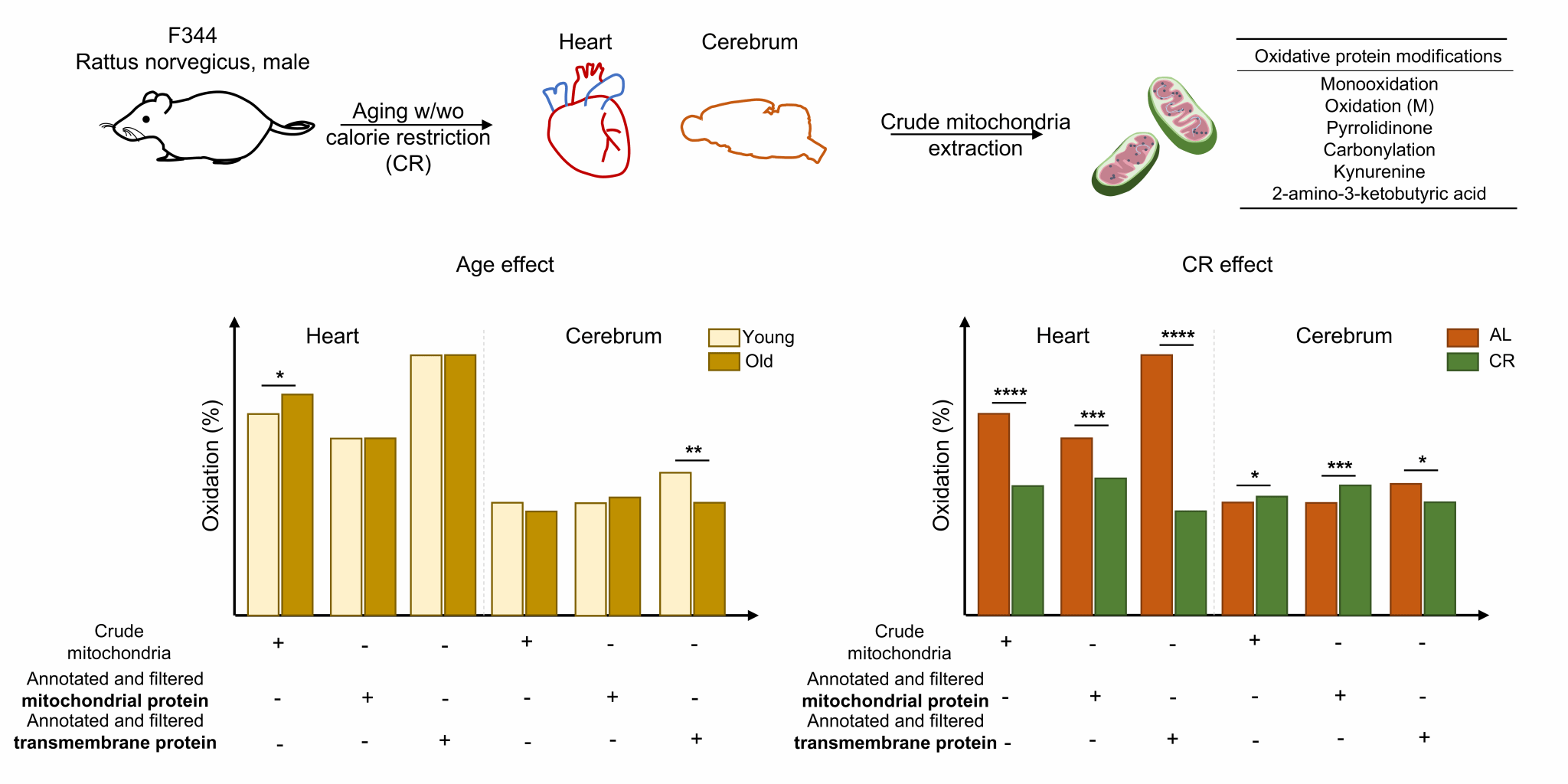 |
This study reveals for the first time that the heart and brain, two high-energy-consuming organs, exhibit distinct protein oxidation response patterns to the same dietary intervention (calorie restriction). It provides a novel proteomic perspective for understanding the molecular mechanisms by which calorie restriction extends health span, and also offers important potential targets for the future development of differential prevention and treatment strategies against cardiovascular diseases and neurodegenerative disorders.
Nanchang University is listed as the first author affiliation. Shipan Fan from the School of Basic Medical Sciences, Nanchang University, and Carina Ramallo-Guevara from Ruhr University Bochum, Germany, contributed equally to this work as co-first authors. Professor Ansgar Poetsch is the corresponding author. This study was supported by the Jiangxi Provincial Foreign Expert Program (Grant No. 9202-0210227525) and the German Federal Ministry of Education and Research (BMBF, Grant No. FKZ 0315584).
Link:https://onlinelibrary.wiley.com/doi/10.1111/acel.70339



 Address: No. 1299 Xuefu Avenue, Honggutan District, Nanchang City, Jiangxi Province
 Tel:+86-0791-83968485
 E-mail:ibi@ncu.edu.cn
 NANCHANG UNIVERSITY

