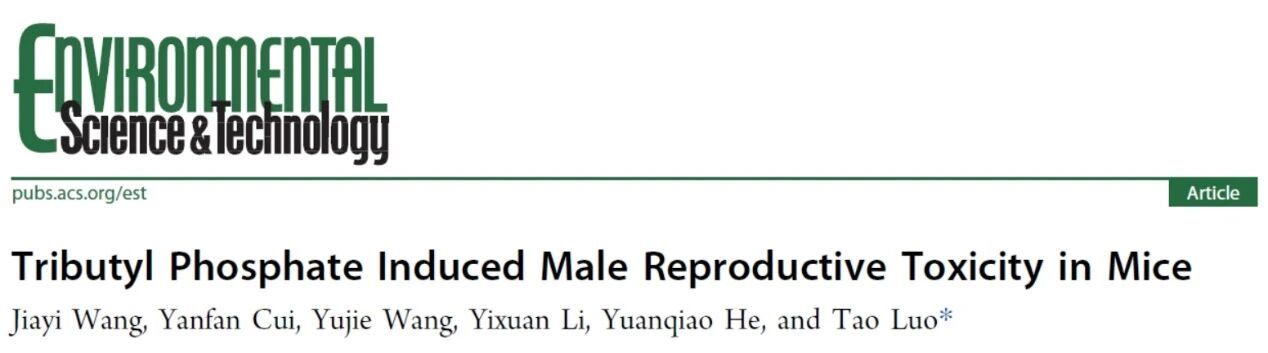
The environmental health issues triggered by nanoplastic pollution are gaining global attention. Recently, Luo Tao's team from our institute published their latest findings titled "Tributyl Phosphate Induced Male Reproductive Toxicity in Mice" in the well-known environmental journal Environmental Science & Technology (impact factor: 10.79). This study is the first to systematically reveal the cross-organ toxicity mechanism of the industrial flame retardant tributyl phosphate (TBP) on the male mammalian reproductive system, providing new evidence for the health risk assessment of environmental pollutants.
Focusing on TBP—a co‑occurring pollutant with nanoplastics—the research adopted a strategy combining in vivo mouse experiments and an in vitro spermatocyte model, establishing a theoretical framework for toxicity along the "gut–testis axis." Experimental data showed that TBP exposure induces gut microbiota dysbiosis and metabolic disturbances, impairing spermatogenesis through multiple pathways such as oxidative stress and apoptosis. Notably, the concentration of TBP detected in human blood (approximately 3 μM) exceeds the dose threshold (1 μM) that induced cytotoxicity in the experiments, suggesting that routine environmental exposure may pose a potential threat to male reproductive health.
Through multi-omics analysis, the research team identified for the first time the key regulatory roles of Prevotellaceae and the IL-17A inflammatory signaling pathway in the reproductive toxicity of TBP. This finding not only expands the dimensions of environmental toxicology research but also provides a theoretical basis for developing future probiotic intervention and anti-inflammatory treatment strategies.
Luo Tao is the corresponding author of the study, and Wang Jiayi, an undergraduate student from Queen Mary University, is the first author. The research was supported by the Regional Program of the National Natural Science Foundation of China and the Natural Science Foundation of Jiangxi Province.



 Address: No. 1299 Xuefu Avenue, Honggutan District, Nanchang City, Jiangxi Province
 Tel:+86-0791-83968485
 E-mail:ibi@ncu.edu.cn
 NANCHANG UNIVERSITY

