Plastic pollution is widely recognized as one of the most pressing environmental issues of the 21st century and has long been a major concern. Once released into the environment, plastic contaminants are extremely difficult to degrade completely. They break down into microplastics (with a particle size of less than 5 mm) and nanoplastics (with a particle size below 1 μm or 100 nm), most of which are invisible to the naked eye. These particles pose significant risks to ecosystems and human health and have been identified by the United Nations Environment Programme as an emerging environmental problem. Polystyrene is one of the most widely used polymers in plastics. Animal model studies have indicated that polystyrene plastics, especially those smaller than 10 μm, possess the potential to induce male reproductive toxicity. Recent research has detected the presence of microplastics in human testes and semen using infrared spectroscopy, identifying polystyrene as the predominant type of microplastic in human testes. However, due to limitations in detection technology, microplastics smaller than 10 μm remain undetectable. Therefore, it remains unclear whether such micro- and nanoplastics contaminate the male reproductive system and whether this contamination contributes to male reproductive toxicity in humans.
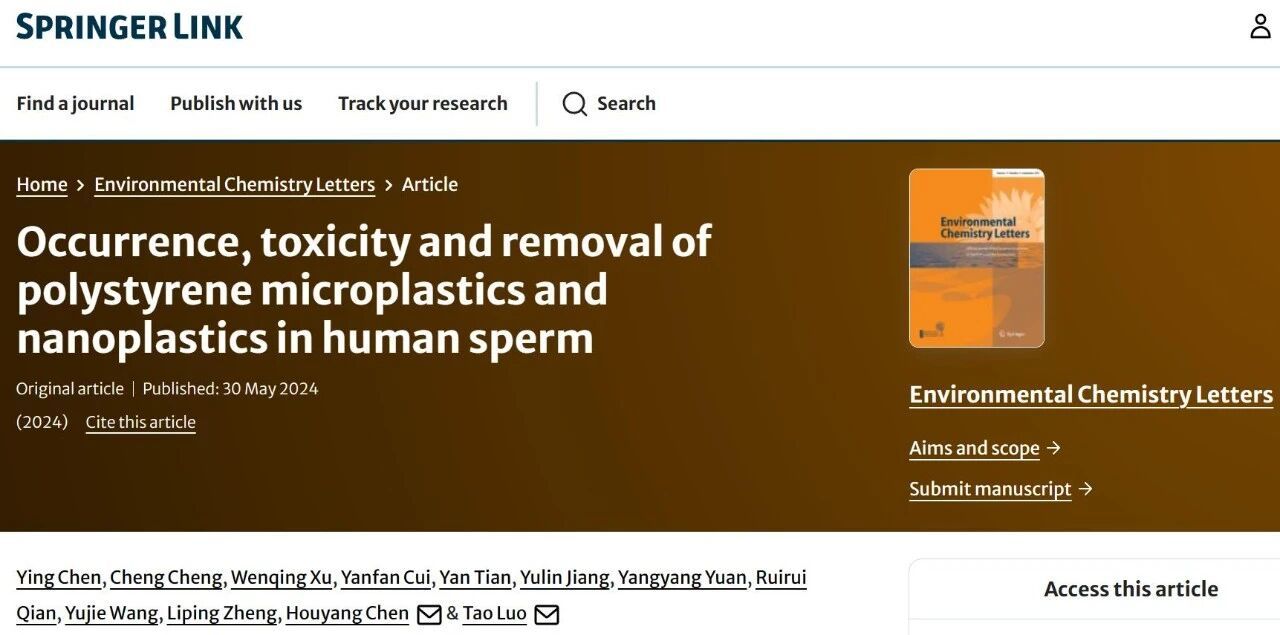
On May 30, Luo Tao’s team from our institute, in collaboration with the team of Deputy Director Chen Houyang from Jiangxi Maternal and Child Health Hospital, published a research paper titled "Occurrence, toxicity and removal of polystyrene microplastics and nanoplastics in human sperm" in Environmental Chemistry Letters (IF: 15.7). This study is the first to identify the presence of polystyrene microplastics smaller than 10 μm in human semen. Specifically, polystyrene nanoplastics with a particle size of 25–100 nm were found to enter human sperm cells, while polystyrene microplastics sized 0.5–10 μm adhered to the sperm surface. At concentrations relevant to human semen, polystyrene nanoplastics (25–100 nm) adversely affected key fertilization functions and physiological parameters, indicating a potential risk to male reproduction. Furthermore, magnetic nano‑iron materials were shown to effectively remove PS‑NPs from solution and eliminate their negative impact on human sperm, offering a promising pre‑exposure intervention strategy. This research expands and refines the understanding of the male reproductive toxicity of micro‑ and nanoplastics, provides new insights into environmental factors behind declining semen quality, and offers a theoretical basis for effectively preventing and mitigating the reproductive toxicity of nanoplastics.
Luo Tao and Chen Houyang are the co‑corresponding authors of the paper. Dr. Chen Ying from our institute, along with Master's students Xu Wenqing and Cheng Cheng, are the co‑first authors. This work was supported by the General Program of the National Natural Science Foundation of China, the Key Project of Jiangxi Province, and the Traditional Chinese Medicine Project of Jiangxi Province.



 Address: No. 1299 Xuefu Avenue, Honggutan District, Nanchang City, Jiangxi Province
 Tel:+86-0791-83968485
 E-mail:ibi@ncu.edu.cn
 NANCHANG UNIVERSITY

