Why do some individuals develop anxiety following prolonged stress, while others remain relatively resilient? Understanding the brain mechanisms underlying these differences is an important challenge in neuroscience. Neurons communicate through synapses, which are continuously formed, modified, and eliminated to maintain normal brain function. However, how chronic stress disrupts this delicate balance within specific neural circuits, thereby influencing vulnerability to anxiety, remains poorly understood.
Recently, research teams led by Professors Pan Bingxing and Zhang Wenhua from our institute/School of Basic Medical Sciences published a research study in PNAS entitled “C1ql2 gates stress vulnerability by regulating microglia-mediated synaptic pruning in the BLA-vHPC circuit.” The study reveals a previously unrecognized mechanism by which interactions between neurons and microglia regulate synaptic remodeling in stress-responsive neural circuits, providing new insights into the neural basis of anxiety vulnerability.
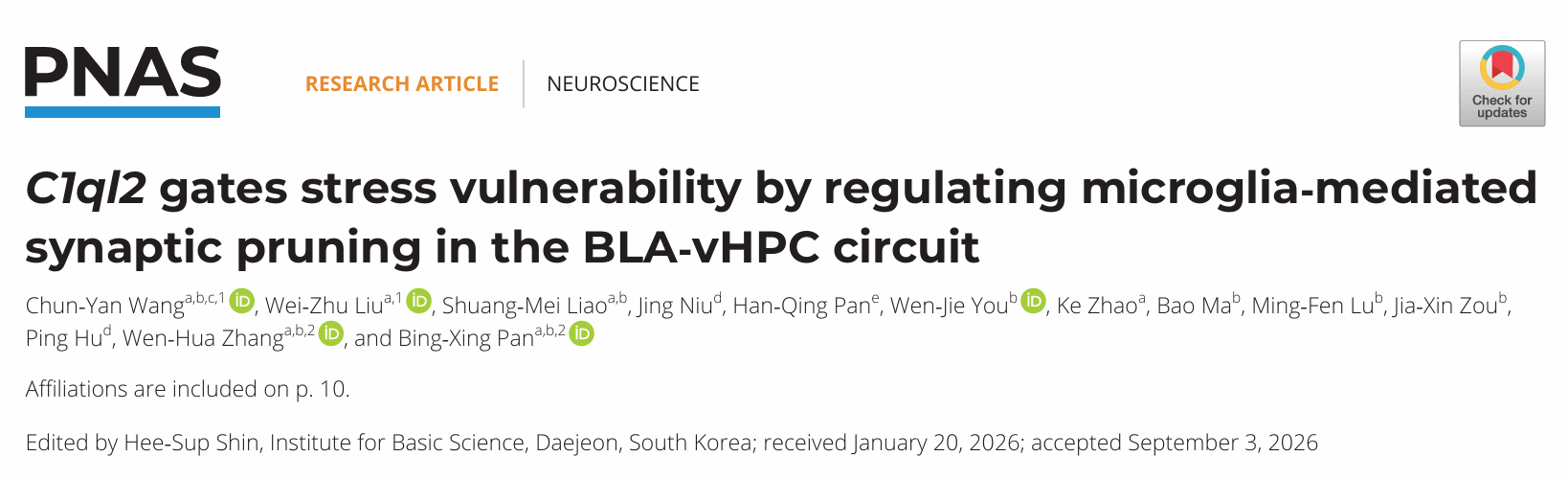
Using a mouse model of chronic social defeat stress, the researchers investigated the amygdala, a brain region involved in emotional processing, and its connections with other brain regions. They demonstrated that chronic stress does not affect all neurons equally. Instead, it selectively alters neurons in the basolateral amygdala (BLA) that project to the ventral hippocampus (vHPC), a neural pathway implicated in anxiety-related behaviors. Further investigation revealed that these changes were closely associated with reduced expression of C1ql2, a C1q-like protein expressed by neurons. By experimentally manipulating C1ql2 expression and examining its effects on synaptic function and behavior, the researchers established its critical role in regulating stress-induced anxiety vulnerability.
Importantly, the team found that C1ql2 acts by regulating interactions between neurons and microglia, the brain's resident immune cells. In addition to their immune functions, microglia help maintain healthy neural circuits by removing unnecessary synaptic connections through a process known as synaptic pruning. Under normal conditions, this process helps maintain an appropriate balance of neural connections. Chronic stress, however, reduces C1ql2 expression in BLA neurons projecting to the vHPC, impairing microglia-mediated synaptic pruning. This disruption leads to an abnormal accumulation of excitatory synapses, enhanced excitatory neurotransmission, and increased anxiety-like behavior in mice.
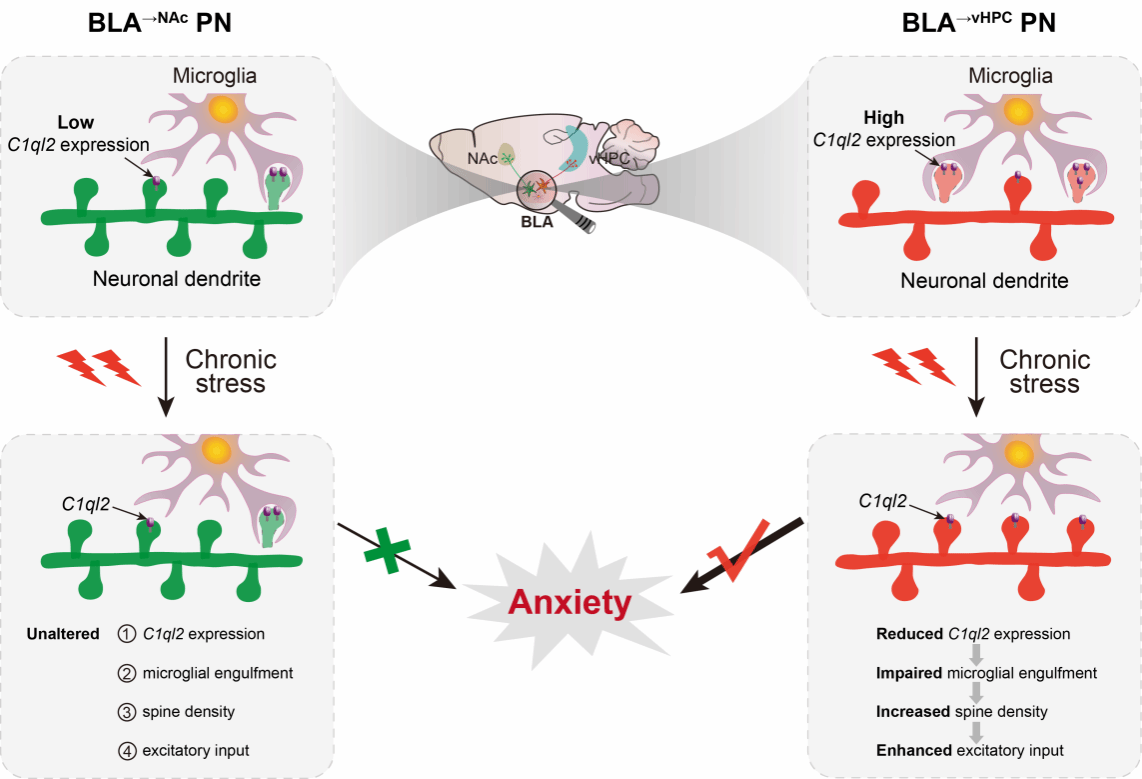
Together, these findings reveal an important mechanism linking chronic stress to anxiety vulnerability. Rather than arising solely from changes within neurons, stress-induced alterations in neural circuit function can also result from disrupted communication between neurons and microglia. By facilitating appropriate synaptic pruning, C1ql2 helps maintain the functional balance of specific emotion-related circuits and limits vulnerability to chronic stress. The study advances our understanding of how neuron-microglia interactions shape emotional behavior and identifies a potential molecular pathway for future investigation into anxiety-related disorders.
Postdoctoral Fellow Chunyan Wang and Associate Research Professor Weizhu Liu from the First Affiliated Hospital of Nanchang University are the co-first authors of the study. Professors Bingxing Pan and Wenhua Zhang from Nanchang University's Institute of Biomedical Innovation and School of Basic Medical Sciences are the co-corresponding authors.
Original link: www.pnas.org/doi/10.1073/pnas.2600854123



 Address: No. 1299 Xuefu Avenue, Honggutan District, Nanchang City, Jiangxi Province
 Tel:+86-0791-83968485
 E-mail:ibi@ncu.edu.cn

 NANCHANG UNIVERSITY


