The liver possesses a robust regenerative capacity, but this capacity declines significantly with age, resulting in slow recovery and poor prognosis after liver injury in the elderly. Vascular endothelial cell dysfunction and insufficient angiogenesis are important causes of the decline in liver regeneration in aging, yet the underlying molecular mechanisms remain unclear. Aging organs exhibit a series of characteristic biological changes, among which imbalanced protein homeostasis is one of the core hallmarks. As a key component of the liver microenvironment, how imbalanced protein homeostasis in endothelial cells drives aging-related regenerative failure is a question worth exploring. Elucidating the molecular mechanisms by which aging leads to imbalanced protein homeostasis in vascular endothelium, and identifying targeted interventions, are of great significance for improving liver health in the elderly population.
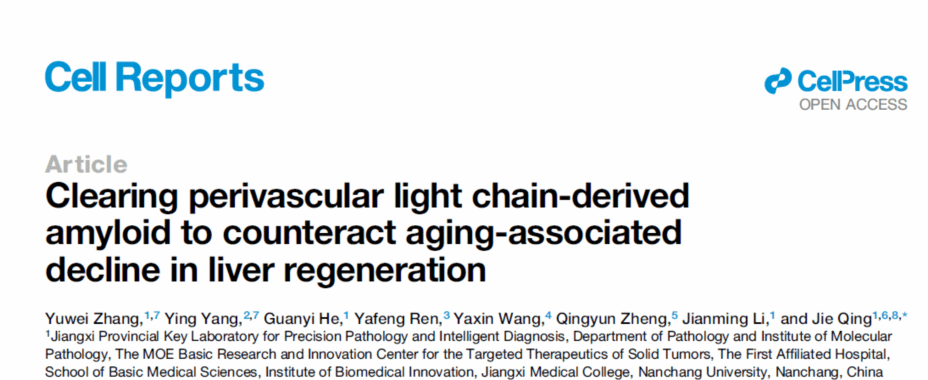
On November 4, Qingjie, an associate researcher at the Biomedical Innovation Research Institute / School of Basic Medical Sciences / Pathology Center of the First Affiliated Hospital of Nanchang University, published a research paper titled "Clearing perivascular light chain-derived amyloid to counteract aging-associated decline in liver regeneration" in the journal Cell Reports. The study reveals that abnormal deposition of light chain-derived amyloid around the vasculature of aging livers can lead to excessive activation of the immunoproteasome in vascular endothelial cells, which is a key driving factor for the decline in liver regenerative capacity; it also confirms that targeted clearance of these amyloid aggregates can restore liver regeneration in aged mice.
Main findings of this study:
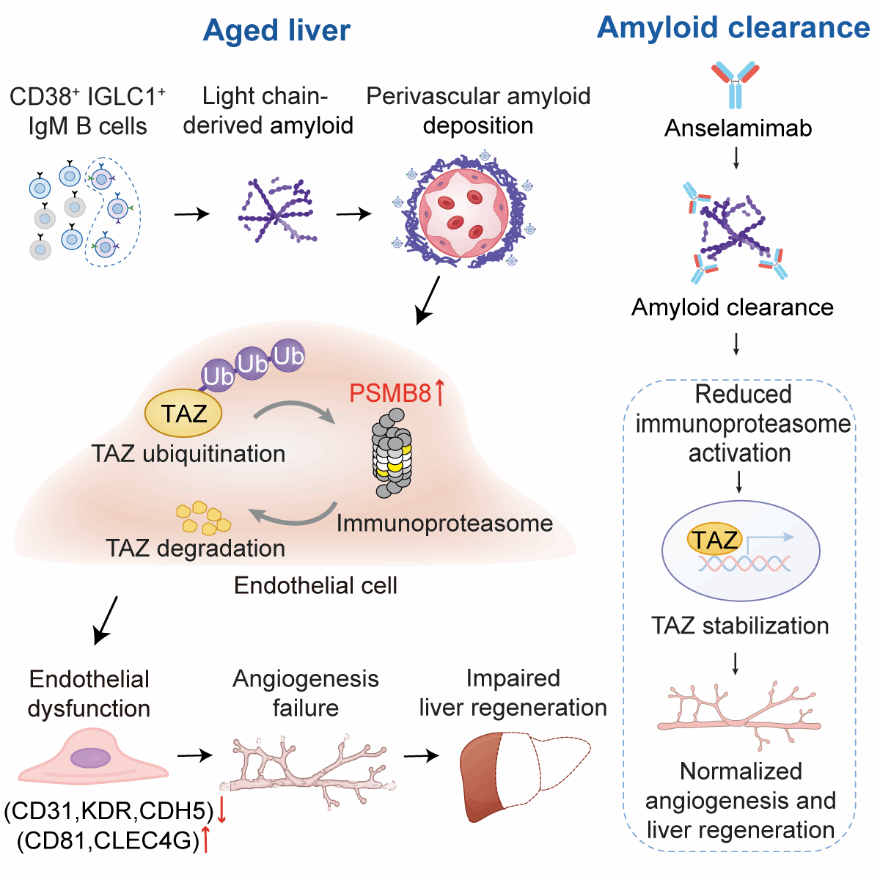
· Identification of the immunoproteasome as a key signal regulating liver regeneration in aging: After partial hepatectomy in aged mice, the immunoproteasome subunit PSMB8 was significantly upregulated in liver vascular endothelial cells. Both tamoxifen-induced conditional deletion of PSMB8 in endothelial cells and treatment with the immunoproteasome-selective inhibitor PR-957 promoted angiogenesis in the aging liver and rescued aging-associated impairment of liver regeneration.
· Identification of downstream substrates of the endothelial immunoproteasome: DiGly ubiquitin proteomics identified TAZ as a substrate degraded via immunoproteasome-dependent ubiquitination, and the key ubiquitination sites (K45/46) were defined; moreover, K29-linked polyubiquitin chains were shown to play an important role in regulating TAZ degradation. Small-molecule activation of endothelial TAZ restored the regenerative capacity of the aging liver.
· Discovery of upstream microenvironmental abnormalities of the immunoproteasome: Single-cell sequencing and other approaches revealed that aging triggers the infiltration of a population of CD38⁺IGLC1⁺ IgM B cells, which secrete light chain-derived amyloid that abnormally deposits around liver blood vessels. Recombinant light chain-derived amyloid fibrils directly induced PSMB8 expression and reduced TAZ levels in vascular endothelial cells in vitro.
· Proposal of a new targeted therapeutic strategy: The humanized antibody Anselamimab, by clearing light chain-derived amyloid, alleviated excessive activation of the endothelial immunoproteasome and restored liver regenerative capacity in aging. Single-cell RNA sequencing further confirmed that this antibody reversed aging-induced loss of endothelial markers and upregulation of inflammatory genes.
This study reveals a "light chain-derived amyloid—endothelial immunoproteasome—TAZ" axis regulating protein homeostasis in aging, providing a therapeutic target with translational potential for improving liver regeneration in the elderly.
Zhang Yuwei, assistant experimentalist at the First Affiliated Hospital of Nanchang University, and Yang Ying, doctoral student at the School of Basic Medical Sciences, are the first (including co-first) authors of the paper; Associate Researcher Qingjie is the sole corresponding author, and Nanchang University is the first institution and corresponding institution of the paper. This research was supported by teams led by Professor Li Jianming from the First Affiliated Hospital of Nanchang University / Biomedical Innovation Research Institute and Professor Liu Lei from the Department of Chemistry at Tsinghua University. This work was supported by National Natural Science Foundation of China (No. 32471232, 22077106) and “Ganpo Talent Program” for Leading Innovative Talents of Jiangxi Province (gpyc20250220).
Original article link: https://www.cell.com/cell-reports/fulltext/S2211-1247(26)01306-9



 Address: No. 1299 Xuefu Avenue, Honggutan District, Nanchang City, Jiangxi Province
 Tel:+86-0791-83968485
 E-mail:ibi@ncu.edu.cn

 NANCHANG UNIVERSITY


