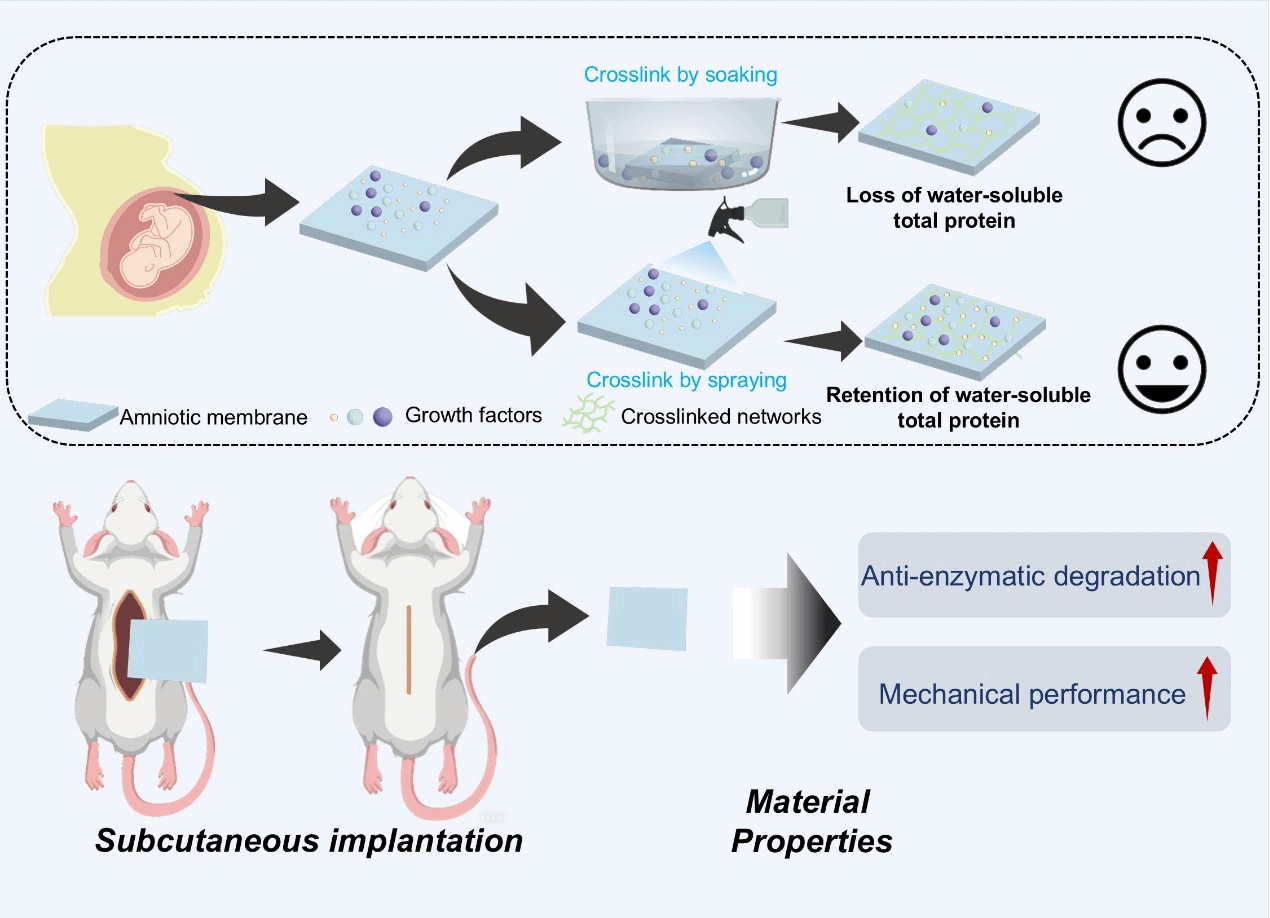
Human amniotic membrane is a highly valuable natural biomaterial in the biomedical field. It is rich in various bioactive components such as cytokines and growth factors, and possesses excellent properties including anti-inflammatory, anti-adhesive, immunomodulatory, and tissue-repair promoting effects. It has been widely used in numerous clinical fields, such as ocular surface reconstruction and repair. However, the clinical application of amniotic membrane is restricted by its poor mechanical strength and rapid in vivo degradation. Although traditional crosslinking and preservation strategies can improve its performance, they frequently result in the loss of water-soluble bioactive components. Furthermore, ultra-low temperature preservation is inconvenient, and freeze-drying causes increased brittleness of the material.
Recently, the research team led by Researcher Lei Yang from our hospital published a research paper entitled “Improved mechanical performance and enzymatic stability of crosslinked dry amniotic membrane by spraying” in the journal Collagen and Leather. The team developed a spray crosslinking technique for preparing dry amniotic membrane. Through the synergistic strategy of “covalent bond network enhancement, hydrogen bond protection, and bioactive component retention”, this technique significantly enhances the mechanical properties and enzymatic stability of amniotic membrane and realizes room-temperature storage, providing a novel strategy for the clinical translation of amniotic membrane–based biomaterials.
The crosslinked dry amniotic membrane developed in this study is expected to overcome the limitations of traditional amniotic membrane, which is only applicable to ophthalmic corneal repair and small-area skin ulcer healing, and further expand its applications to the following fields:
l Spinal and neural protection: Providing anti-inflammatory, wrapping protection and anti-adhesion effects for spinal and neural tissues.
l Tendon injury repair in hand surgery: Addressing postoperative tendon adhesion—a common complication in hand trauma that severely impairs functional recovery.
l Endometrial repair in obstetrics and gynecology: Serving as a physical barrier to inhibit bacterial migration and prevent adhesion of endometrial tissues.
Researcher Yang Lei from our institute is the corresponding author, and Yue’e Wang and Liyang Cao from the School of Basic Medical Sciences are the co-first authors. Nanchang University is the corresponding institution of this paper.
Original link: https://link.springer.com/article/10.1186/s42825-026-00241-0



 Address: No. 1299 Xuefu Avenue, Honggutan District, Nanchang City, Jiangxi Province
 Tel:+86-0791-83968485
 E-mail:ibi@ncu.edu.cn
 NANCHANG UNIVERSITY

