Small-conductance calcium-activated potassium channels (SK channels) are widely distributed in the nervous system and various muscle tissues, where they finely regulate cellular excitability and calcium signaling by modulating the afterhyperpolarization potential during action potentials, thereby playing critical roles in physiological processes such as synaptic plasticity, learning and memory, and cardiac rhythm. In 2019, this team first reported that chronic stress selectively downregulates SK2 expression in neurons projecting from the basolateral amygdala to the ventral hippocampus, leading to hyperactivation of this circuit and inducing anxiety-like behavior (Biological Psychiatry, 2019), which laid an important foundation for understanding the involvement of SK2 channels in mood disorders. Given the key roles of SK channels in atrial fibrillation, ataxia, epilepsy, anxiety disorders, and neurodegenerative diseases, they have emerged as important drug targets. Currently, various small-molecule modulators targeting SK2 channels have entered clinical trials, such as the SK channel inhibitor AP30663 for the treatment of atrial fibrillation (Phase II clinical trial) and the agonist CAD-1883 for the treatment of essential tremor (Phase II clinical trial). However, the precise molecular mechanisms by which these clinical candidates and classical modulators act on SK2 channels remain unclear.
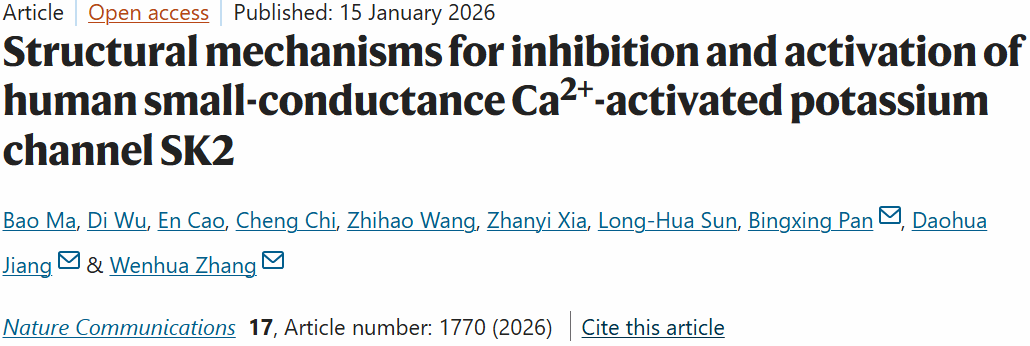
On January 15, 2026, the teams of Researchers Pan Bingxing and Zhang Wenhua from our institute/School of Basic Medicine, in collaboration with the team of Researcher Jiang Daohua from the Institute of Physics, Chinese Academy of Sciences, published a research paper titled "Structural mechanisms for inhibition and activation of human small-conductance Ca2+-activated potassium channel SK2" in Nature Communications. Using cryo-electron microscopy, this study resolved high-resolution structures of the human SK2-CaM complex bound to apamin, UCL1684, CAD-1883, and AP30663, systematically revealing that SK2 channels possess multiple functional regulatory sites and exhibit distinct activation and inhibition mechanisms, thereby providing key structural foundations for a deeper understanding of SK2 channel activation and for rational drug design targeting SK2 channels.
The study reveals that SK2 forms a homotetramer in a non-domain-swapped manner, with each subunit comprising a voltage-sensor-like domain (S1–S4) and a pore domain (S5–S6), which are connected by an S4–S5 linker consisting of two short α-helices (S45A and S45B). S6 extends into two long, chopstick-like helices, HA and HB, oriented parallel to the membrane plane. Notably, four hairpin-like S3–S4 loops point toward the central axis of the channel and collectively form the extracellular vestibule of SK2, a domain that is markedly distinct from that of the SK4 channel. The C-lobe of calmodulin (CaM) binds to the HA helix of one subunit, whereas the N-lobe interacts with the S45A helix of the adjacent subunit (Figure 1).
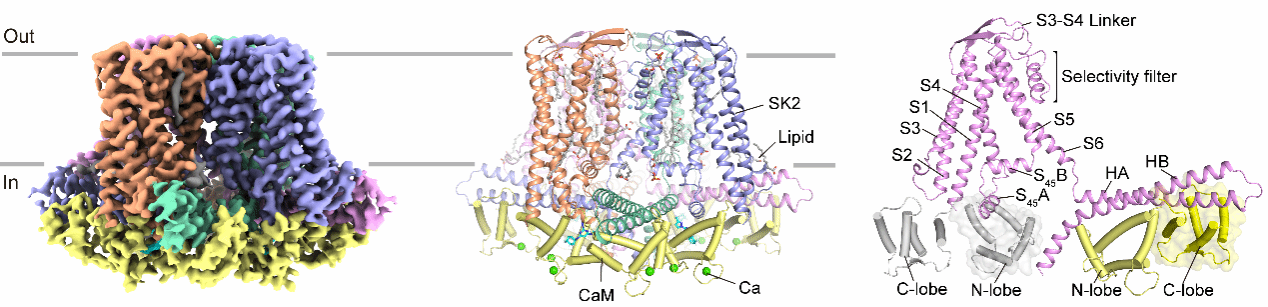
Figure 1 Schematic diagram of the cryo-EM structure of SK2
This study reveals three distinct regulatory sites in the SK2 channel and their detailed modes of action (Figure 2), providing a structural basis for the Ca²⁺-dependent activation of SK channels, the mechanisms of inhibition by drug molecules, activation mechanisms, and pharmacology, and offers a precise template for the development and optimization of SK channel modulators.
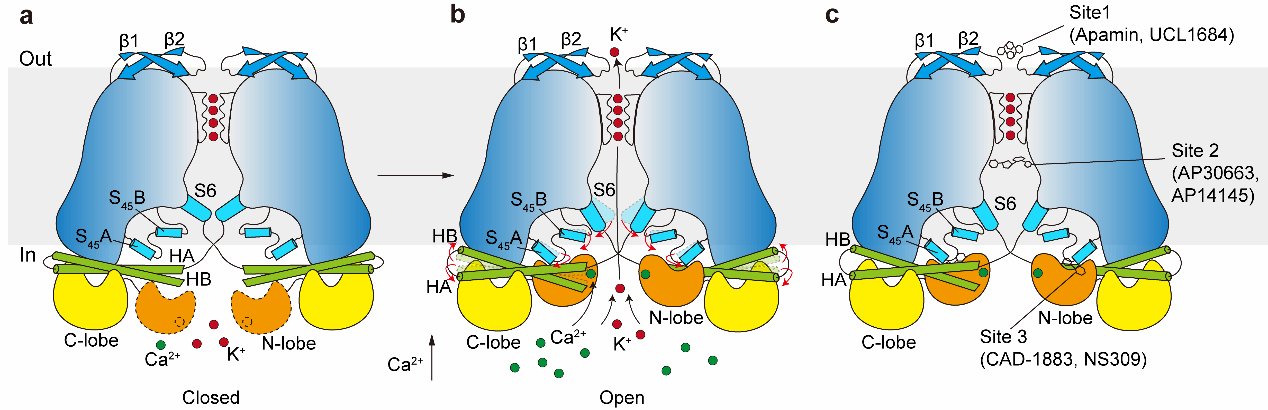
Figure 2 Model depicting the activation and regulatory mechanisms of SK2
Researchers Pan Bingxing and Zhang Wenhua from our institute/School of Basic Medicine, and Researcher Jiang Daohua from the Institute of Physics, Chinese Academy of Sciences, are the co-corresponding authors of this paper. Doctoral students Ma Bao and Cao En from the School of Basic Medicine, Nanchang University, postdoctoral fellow Wu Di from the Institute of Physics, Chinese Academy of Sciences, and Professor Chi Cheng from the Institute of Advanced Agricultural Sciences, Peking University, are the co-first authors.
Original link: https://doi.org/10.1038/s41467-026-68475-4



 Address: No. 1299 Xuefu Avenue, Honggutan District, Nanchang City, Jiangxi Province
 Tel:+86-0791-83968485
 E-mail:ibi@ncu.edu.cn
 NANCHANG UNIVERSITY

